
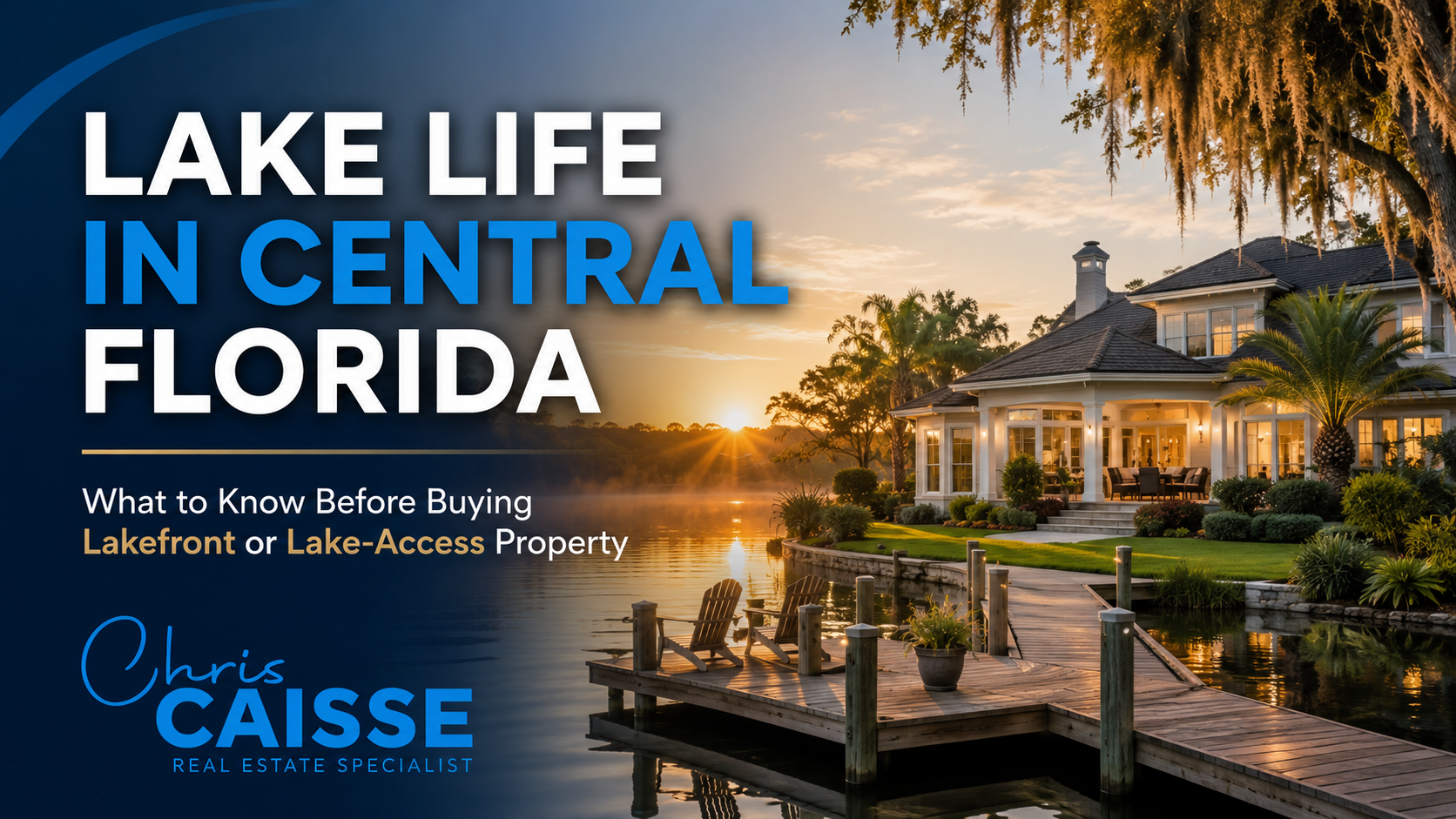
Central Florida sits on top of one of the most lake-dense landscapes in the country. Lake County alone has more than 1,400 named lakes. Marion County, Sumter County, and the broader corridor stretching from Ocala south toward Clermont and Minneola is loaded with freshwater that draws buyers who want to wake up to water every single morning.
That picture is genuinely appealing. But lakefront and lake-access properties in Central Florida come with a set of considerations that most buyers from outside the state have never thought about. Water rights, dock permits, flood insurance changes, and seasonal water quality issues all factor into the true cost and experience of owning on the water here.
This is not a reason to walk away from lake property. It is a reason to walk in with your eyes open.
Lakefront and Lake-Access Are Not the Same Thing
This distinction catches more buyers off guard than almost anything else in Central Florida real estate.
A true lakefront property means the lot directly borders the lake. The water is your backyard. Your deed should reflect a property line that reaches the ordinary high-water mark of the lake itself.
A lake-access property is something different. The home may sit in a neighborhood that has a shared community dock, a common green space at the water, or a deeded easement granting residents the right to use a particular access point. That can be a perfectly enjoyable setup, but it is not the same as having a private shoreline. You may share that access with dozens of neighbors, and your ability to keep a boat there or build a private dock may be limited or nonexistent.
Before you fall in love with any listing that markets itself with lake views or lake access, get the deed language in front of an attorney and confirm exactly what rights transfer with the property.
Riparian Rights: What They Actually Mean in Florida
Florida law gives the state ownership of all sovereign submerged lands, meaning the land beneath navigable waters. What you own as a lakefront property owner is the upland parcel that touches the water.
Your riparian rights as an upland owner include reasonable access to the water, the right to fish, the ability to boat and swim, and generally the right to construct a dock out to navigable water. That last right is real, but it is qualified. It does not mean you can automatically build whatever structure you want. It means you have standing to apply for permits, and the outcome of that process depends on the specifics of your site.
A few things worth knowing: Riparian rights are tied to the land itself, not to you personally. They transfer with the property. But the existence of riparian rights on a deed does not guarantee that a dock you are planning will be approved, that an existing dock was ever properly permitted, or that any prior shoreline work was done legally.
Always verify whether existing water structures on any property you are considering were permitted. If they were not, that liability can follow you after closing.
Dock Permits: The Process Is More Layered Than Most Buyers Expect
Building or modifying a dock on a Central Florida lake involves at least two regulatory bodies and sometimes three.
The Florida Department of Environmental Protection regulates dock construction statewide. Some smaller residential docks qualify for an exemption, which you can self-certify online at no cost, though DEP may still require a free consent of use for work on sovereign submerged lands. If your project does not qualify for an exemption, you are looking at a general permit through DEP, which carries a $250 application fee and a review timeline that can stretch well beyond 30 days.
If the waterway is considered navigable by the U.S. Army Corps of Engineers, federal review may also apply, particularly if the work could affect navigation or protected habitats.
Your county may layer on additional requirements. Lake County, Marion County, and the municipalities within them each have their own setback rules, wetland buffer requirements, and building permit processes. These do not replace the state and federal process. They stack on top of it.
The practical takeaway: if you are counting on adding or expanding a dock, do not assume the listing photos tell the full story. Get a permit history search done during due diligence and consult with a contractor who works specifically in Florida waterfront permitting before you go under contract.
Flood Insurance: Risk Rating 2.0 Changed the Math
FEMA fully implemented its Risk Rating 2.0 pricing methodology in April 2023, and it fundamentally changed how flood insurance premiums are calculated for lakefront and lake-adjacent properties.
Under the old system, your flood zone designation and base flood elevation were the primary drivers of cost. Under Risk Rating 2.0, FEMA now factors in the distance from flood sources, the type of flooding likely at your specific parcel, building characteristics, and replacement cost value. Two homes on the same lake in the same neighborhood can carry very different premiums.
For Central Florida, current average National Flood Insurance Program premiums vary significantly by location. Marion County policyholders average around $590 per year, which is on the lower end of the Florida spectrum. Lake County and Sumter County properties vary widely based on elevation and proximity to water. In higher-risk zones designated AE or A, annual premiums can push well past $2,000 through NFIP, though private market carriers are increasingly competitive and sometimes come in several hundred dollars lower.
One critical detail: NFIP policies carry a 30-day waiting period before coverage goes into effect. Private policies often have shorter waiting periods, sometimes as few as two to ten days. If you are purchasing lakefront property, get flood insurance quotes early in the transaction, before you are under any time pressure.
Do not assume a property outside an official high-risk flood zone needs no flood insurance. FEMA data shows that roughly 25 percent of all flood claims come from moderate-to-low risk zones. A lakefront property in Zone X may still flood under the right conditions, and coverage in that zone can be surprisingly affordable.
Water Quality: A Factor That Rarely Makes the Listing Description
Central Florida's freshwater lakes deal with blue-green algae blooms, formally called cyanobacteria, with regularity during the warmer months. Blooms are more common from summer through fall when water temperatures rise, sunlight is intense, and nutrients accumulate in slower-moving water.
Marion County's Department of Health has issued blue-green algae advisories on multiple local lakes including Lake Weir, Lake Bryant, and Orange Lake within the past year. The Florida Department of Environmental Protection maintains an active algal bloom dashboard where you can look up any lake in the state and see its monitoring history.
This does not mean lakefront living is unsafe. It does mean that any buyer purchasing on a specific lake should look up that lake on the DEP dashboard before closing, understand what blooms have occurred historically, and be aware of precautions during active advisories, which include staying out of visibly bloomed water and keeping pets away from affected areas.
Some lakes in the corridor are significantly cleaner than others. Water quality varies based on watershed land use, development density around the shoreline, and depth. Knowing which lake you are buying on, not just that a lake is nearby, is part of doing this purchase right.
The Survey Matters More on Waterfront Property
A standard boundary survey on an inland home is important. On lakefront, it becomes essential.
The ordinary high-water line of a lake is not always where it visually appears to be, and it moves over time with changing water levels. A dock that the seller believes sits on their property may actually encroach on neighboring riparian boundaries or on sovereign submerged lands without proper authorization. Side yard easements and shoreline access paths that feel intuitive based on years of use can tell a very different story when formally surveyed.
Order the survey early. Review title exceptions carefully for any recorded easements, deed restrictions, or riparian language. And verify the permit history of any existing dock, seawall, or shoreline modification before you assume it is yours to inherit free and clear.
Frequently Asked Questions
Do lakefront properties in Central Florida always include private dock rights?
Not automatically. Riparian rights give you standing to pursue dock permits, but approval depends on site-specific environmental and regulatory factors. Verify permit history and consult with a waterfront permitting specialist during due diligence.
Is flood insurance required for lakefront property in Central Florida?
Lenders will require it if the property falls within a designated Special Flood Hazard Area. Even outside those zones, many lakefront buyers carry flood coverage given the proximity to water. Always get quotes early since NFIP has a 30-day waiting period.
How do I check water quality for a specific Central Florida lake?
The Florida Department of Environmental Protection maintains a public Algal Bloom Dashboard at protectingfloridatogether.gov where you can search any lake by name and see current and historical monitoring data.
What is the difference between lakefront and lake-access when buying a home?
Lakefront means the property lot directly borders the lake with your own shoreline. Lake-access typically means a shared or deeded right to use a common access point, dock, or community waterfront area. Review deed language carefully to understand exactly what you are purchasing.
What agencies are involved in dock permitting on a Central Florida lake?
At minimum the Florida Department of Environmental Protection. The U.S. Army Corps of Engineers may also have jurisdiction if the waterway is navigable. Your county and municipality layer on their own permitting and setback requirements on top of state and federal review.
Chris Caisse is a licensed Realtor with eXp Realty and a Certified Master Inspector serving buyers and sellers across Central Florida's lake communities, including Lake County, Marion County, Clermont, Minneola, Windermere and the greater Villages corridor.
Ready to talk through a specific property or market? Book a free call at calendly.com/ccaisse24/30min or reach Chris directly at 352-761-9492.
Check out this article next