

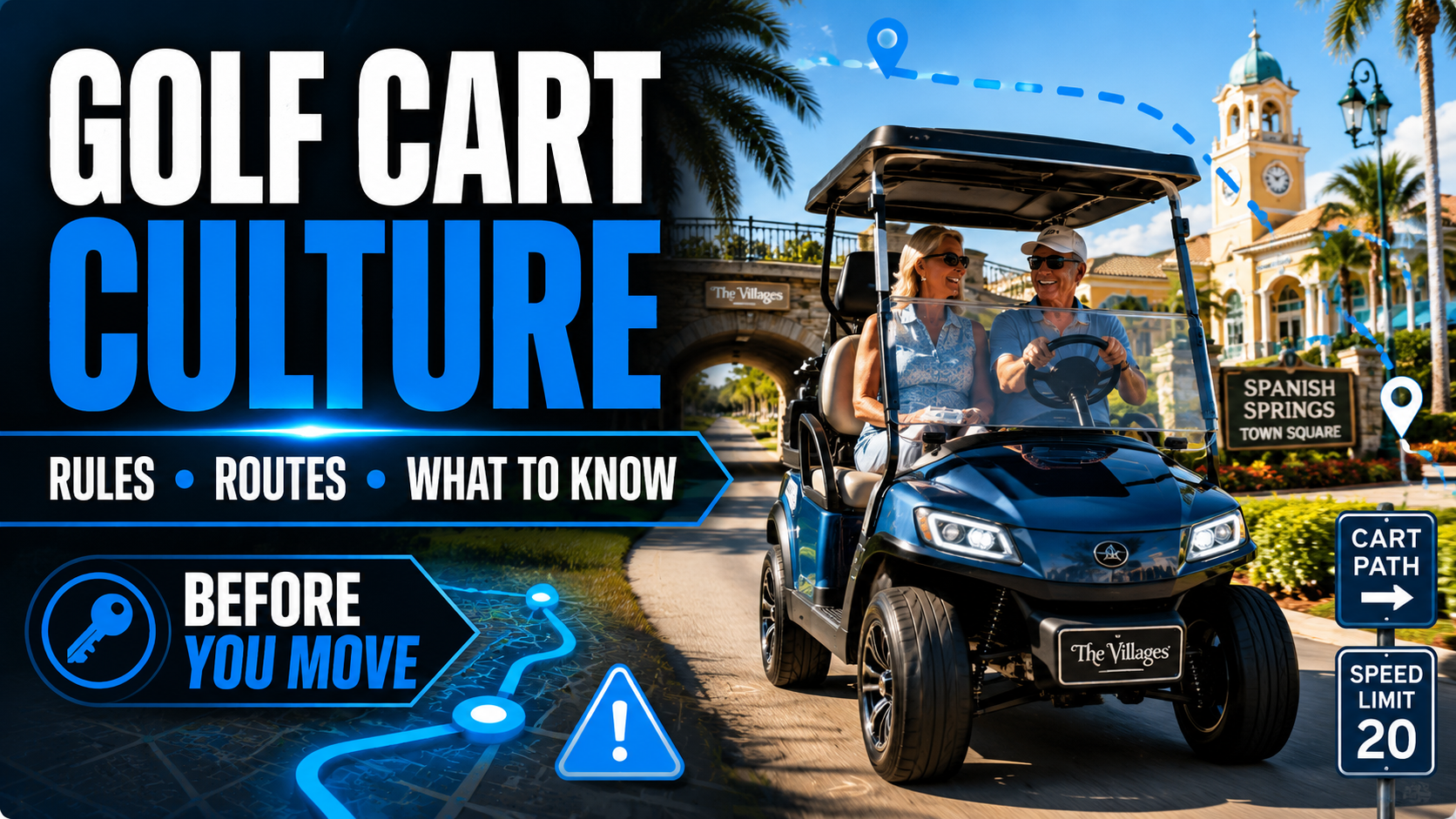
If you are moving to The Villages, the golf cart is not a toy and it is not a golf accessory. It is your second car, and for a lot of residents it becomes the first one. People here run errands, go to dinner, get to church, hit happy hour at the squares and drive to the doctor without ever starting a vehicle. Understanding how that system works before you buy a home will save you money and frustration.
I moved to Florida from New Hampshire in 2024, so I went through the learning curve myself. Here is what actually matters.
Why the Golf Cart Runs This Community
The Villages was designed around cart travel from the beginning. A separate network of multi modal paths, tunnels and bridges lets carts move under and over major roads instead of fighting traffic on them. Town squares, recreation centers, executive courses, shopping plazas and medical offices all have cart parking. Many restaurants have more cart spaces than car spaces during dinner hours.
That design is also why cart access shows up in home values. Two similar homes can price differently based on how easy it is to reach a square, a rec center or a grocery plaza by cart.
The Rules That Actually Matter
Golf Cart vs. Low Speed Vehicle
Most new residents do not realize these are two legally different vehicles in Florida. The distinction controls where you can drive.
| Item | Golf Cart | Low Speed Vehicle (LSV) |
|---|---|---|
| Top speed | 20 mph or less | Greater than 20 mph, up to 25 mph |
| Title and registration | Not required | Required |
| License plate | No | Yes |
| Insurance | Not required by state law | Required, including PIP and property damage liability |
| Driver license | Not required for age 18 and over | Required for all drivers |
| Required equipment | Brakes, steering, safe tires, mirror, reflectors | Headlights, turn signals, brake lights, tail lights, mirrors, parking brake, windshield, seat belts, VIN |
| Roads allowed | Designated cart accessible roads posted 30 mph or less | Streets posted 35 mph or less |
If you want to drive on more roads and cross more intersections, you want an LSV, not a standard cart. That decision changes your budget by several thousand dollars.
Age and License Requirements
Florida tightened this. Under current state law and the District's published rules:
- Under 15: not permitted to operate
- Age 15: learner's permit required, with a licensed driver present
- Age 16 to 17: valid driver license required
- Age 18 and over: golf cart operators need a valid government issued photo ID in their possession, LSV operators need a driver license
This matters when grandchildren visit. Handing the cart keys to a 14 year old is a violation, not a technicality.
Where You Can and Cannot Drive
This is the number one thing new residents get wrong. Golf carts are limited to designated cart accessible roadways posted at 30 mph or less, and you must stay in the marked diamond lane or along the right edge. The District's rules prohibit golf carts on US 27/441, CR 466 and CR 466A, and on roads posted above the limit. Golf carts are also not allowed on sidewalks.
To get across the big roads, you use the tunnels and bridges. Marked tunnels handle crossings under El Camino Real, Buena Vista Boulevard and Morse Boulevard. Cart bridges carry traffic over barriers like State Road 44 and the Florida Turnpike, which is how the northern and southern sections stay connected.
An LSV has more freedom. It can travel streets posted at 35 mph or less and cross higher speed roads at controlled intersections.
Night Driving
Florida limits golf cart operation on public roads to between sunrise and sunset unless the governing body allows night use and the cart is equipped with headlights, brake lights, turn signals and a windshield. In practice, most carts here are equipped for evening driving, but a bare bones cart is not legal after dark.
DUI Applies
Florida DUI law covers golf carts. The squares serve alcohol and the sheriff patrols the paths. Every season brings arrests. Treat the cart like a car.
The Routes: How Far Can You Actually Go
The path system connects a large portion of the community, but it is not infinite and it is not equally convenient everywhere. Paths are designed for speeds of 20 mph or less. Pedestrians, bicycles, e bikes and carts share the same surface, so peak hours near squares and rec centers move slowly.
Before you buy, drive the actual route from the home to the three places you will go most. Time it. A home that looks close on a map can be a 25 minute cart ride once you account for tunnel routing and traffic. Homes in the newer southern sections often sit farther from established squares, and that is worth knowing before you commit.
What Nobody Tells You Before You Move
Range is the real constraint. A lead acid battery pack loses capacity as it ages, and Florida heat is hard on batteries. Lithium packs charge faster, last longer and hold range better, but they add roughly $1,500 to $4,000 to the cost. Buyers who skip this step end up stranded at a square with a dying charge.
Used carts hide their biggest expense. Battery condition drives value more than model year. Budget $800 to $2,000 for a replacement pack on any used cart with unknown battery history.
Budget realistically. New standard carts commonly run in the $7,000 to $18,000 range depending on options, and street legal LSVs typically start higher. Custom builds around here go far above that. Used carts can be found in the low thousands, with the battery caveat above.
Weather is a factor. Summer afternoon storms are daily events from June through September. You will want a roof, a windshield and rain enclosure panels. The heat is also real, so plan around midday.
Safety is not theoretical. The Sumter County Sheriff's Office reported 54 golf car crashes in the first quarter of 2024 alone, putting the community on pace for over 200 in a year. Seat belts are not required on standard golf carts. Many residents add them anyway.
Insurance is worth a call. State law does not require insurance on a standard golf cart, but liability coverage is inexpensive and your homeowners policy may not extend the way you assume. Ask your agent directly.
Storage matters at resale. Homes with a dedicated golf cart garage, sometimes called a one and a half or two and a half car garage, hold broader buyer appeal. If you are looking at a home without one, factor that into your offer and your future exit.
The amenity fee does not cover your cart. The $204 monthly amenity fee funds recreation and community amenities. Cart purchase, maintenance, batteries and insurance are all separate.
How This Should Shape Your Home Search
Cart access is a pricing input, not a lifestyle detail. When I preview homes with buyers, I look at cart garage configuration, the route to the nearest square and rec center, tunnel access from the neighborhood, and whether the driveway and garage depth actually fit the cart you plan to own. Those four things affect both daily enjoyment and resale.
One note on rules: District regulations and county ordinances do get updated. Before you rely on any specific route or restriction, confirm current rules with District Government or verify with a licensed Florida attorney if a legal question is involved.
Frequently Asked Questions
Do you need a driver license to drive a golf cart in The Villages?
Not if you are 18 or older, but you must carry a valid government issued photo ID. Drivers age 16 and 17 need a license, and 15 year olds need a learner's permit with a licensed driver present.
Can you drive a golf cart on CR 466 or 441?
No. Golf carts are prohibited on US 27/441, CR 466 and CR 466A. Use the tunnels, bridges and designated cart accessible roads instead.
What is the difference between a golf cart and an LSV?
A golf cart tops out at 20 mph and needs no title, plate or insurance. An LSV reaches up to 25 mph and requires title, registration, insurance, safety equipment and a licensed driver.
Can you drive a golf cart at night in The Villages?
Only if the cart is properly equipped with headlights, brake lights, turn signals and a windshield, consistent with Florida law and local approval.
How much does a golf cart cost in The Villages?
New standard carts commonly run $7,000 to $18,000, street legal LSVs generally start higher, and used carts range widely depending on battery condition.
Thinking about a move to The Villages and want to know which neighborhoods actually give you the cart access you are picturing? I am Chris Caisse with eXp Realty. I help buyers and sellers across The Villages and Central Florida every week.
Call or text 352-761-9492
Email [email protected]
Book a private call at calendly.com/ccaisse24/30min
More at chriscaissere.com
Check out this article next